The marketing director had been crushing it for eight years. Industry awards, successful campaigns, consistent results. But during our conversation, she said something that stopped me cold:
“I used to feel confident in every meeting. Now I wonder if I’m becoming irrelevant.”
She wasn’t imagining it. The skills that made her successful were quietly losing their value, and she was starting to feel it.
The Half-Life of Professional Skills Is Shrinking
Here’s a reality most professionals aren’t prepared for: your expertise has an expiration date, and it’s approaching faster than you think.
Research from IBM shows that the half-life of learned skills is now just 2.5 to 5 years for most professions. In technology, it’s down to 18 months. This means that half of what you know today will be less relevant or completely obsolete within a few years.
But here’s what the research doesn’t capture: the psychological impact of watching your hard-earned expertise slowly become less valuable.
The Warning Signs You Can’t Ignore
Most professionals don’t wake up one day and realize their skills are outdated. It happens gradually, through signals that are easy to dismiss:
You’re not invited to the strategic conversations anymore. Suddenly, decisions that affect your work are being made without your input. Your expertise, once valued, feels sidelined.
Younger colleagues are getting opportunities you expected. They’re speaking a language, whether it’s AI tools, new methodologies, or emerging frameworks, that you haven’t learned yet.
You’re working harder for the same results. What used to feel effortless now requires extra effort. You’re compensating for skill gaps with longer hours rather than addressing the root issue.
Industry conversations feel foreign. At conferences or networking events, the topics that energize everyone else leave you feeling behind. The vocabulary has shifted, and you’re not fluent in the new language.
Why Smart People Fall Behind
The professionals most at risk aren’t the ones who lack ambition. They’re often the ones who’ve been most successful with their current skill set.
Success creates comfort. When your expertise has served you well, there’s less urgency to update it. You’ve built credibility and relationships based on what you know. Why risk that by admitting you need to learn something new?
This is what psychologists call the “competency trap,” continuing to rely on skills that worked in the past, even when they’re becoming less effective.
The Compounding Cost of Skill Stagnation
Skill decay isn’t just about falling behind technically. It affects every aspect of your professional life:
Decision-making confidence erodes. When you’re not sure you understand all the variables, you hesitate. Hesitation becomes a pattern.
Network value diminishes. Your ability to provide insights and add value in professional relationships depends on staying current. Outdated knowledge makes you less useful to your network.
Career mobility freezes. The gap between what you know and what’s needed for advancement grows wider. Moving up or moving out becomes increasingly difficult.
Earning potential plateaus. Companies pay premiums for cutting-edge skills. As your skills age, so does your market value.
Start With Your Values Portfolio, Not Your Skill Portfolio
Before you build your skill portfolio, reconnect with your values portfolio because your future shouldn’t be built only on what’s marketable but on what’s meaningful.
The professionals who navigate skill transitions most successfully don’t just ask “What should I learn?” They ask “Who am I becoming?” and “What legacy am I building?”
Clarify your identity evolution. Instead of randomly updating skills, identify the professional identity you’re growing into. Are you becoming a strategic advisor? A creative problem-solver? A bridge-builder between functions? Let that vision guide your learning priorities.
Align skills with values. Every new capability should serve both market demands and personal purpose. If collaboration energizes you, focus on skills that enhance your ability to facilitate and lead teams. If innovation drives you, invest in capabilities that position you at the forefront of change.
The Strategic Response: Strengths-Based Skill Evolution
What if the skills you need are already latent in you, just waiting to be activated? You don’t need to become someone else. You need to evolve from the best parts of who you already are.
Start with your existing strengths. List not just your technical skills, but your natural talents the things that come easily to you that others find difficult. Pattern recognition? Relationship building? Systems thinking? These are your foundation for skill expansion.
Identify the “skill adjacent” areas. Look for capabilities that build on your natural strengths but extend into emerging areas. If you’re naturally analytical, explore data storytelling. If you’re a natural connector, develop digital community-building skills.
Create learning habits that honor your style. Instead of forcing yourself into generic training programs, design learning approaches that work with your natural preferences. Some people learn by teaching others. Some learn by experimentation. Some learn through deep research. Honor your learning style.
Seek skill-building assignments that energize you. Volunteer for projects that stretch your capabilities while still connecting to what motivates you. Use your existing role as a laboratory for becoming who you’re meant to be professionally.
The Identity Shift That Changes Everything
The most successful professionals I work with have made a fundamental identity shift: they’ve stopped thinking of themselves as collections of skills and started thinking of themselves as evolving leaders with a unique contribution to make.
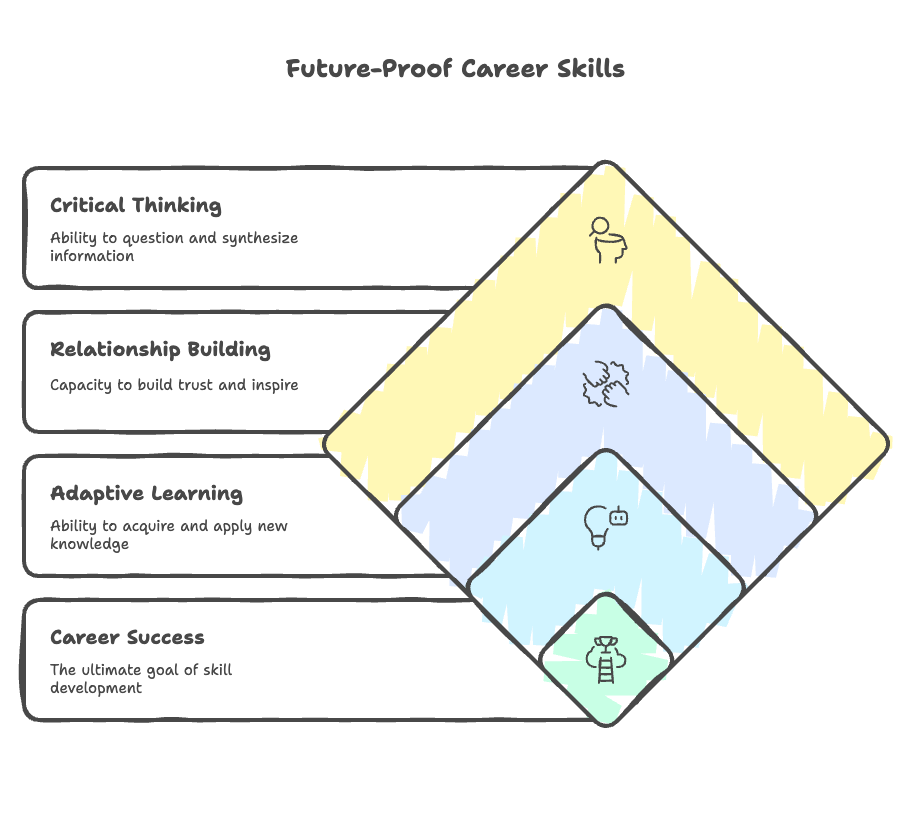
This isn’t about becoming a perpetual student. It’s about recognizing that your ability to learn, adapt, and apply new knowledge in service of your larger purpose is your most durable competitive advantage.
Your current expertise got you here. Your commitment to becoming who you’re meant to be will get you where you want to go.
Your Next Move
Take 15 minutes this week to research the top three skills emerging in your field. Don’t overthink it. Just understand what’s coming.
Then ask yourself: If I had to learn one new capability this year to stay competitive, what would it be?